API 11AX ball and seat are the critical sealing pair inside a subsurface sucker rod pump. The ball lifts off the seat on the up-stroke to let fluid enter, then seals on the down-stroke to push fluid upward. API 11AX is the API specification that defines their dimensions, materials, and performance.
Common materials include 9Cr18Mo and 6Cr18Mo stainless steel, cobalt-chromium-tungsten alloy (Stellite), YG8/YG13 tungsten carbide, titanium carbide-based hard alloy, and non-magnetic nickel-based alloy. Selection depends on well fluid, sand content, temperature, and pressure.
V11 and V13 are API 11AX valve series with different dimensional envelopes. V11 covers common pump sizes from V11-106 to V11-275. V13 is a larger, heavier-duty series for higher-volume or deeper wells. Both can be supplied in matching sets with material selected for well conditions.
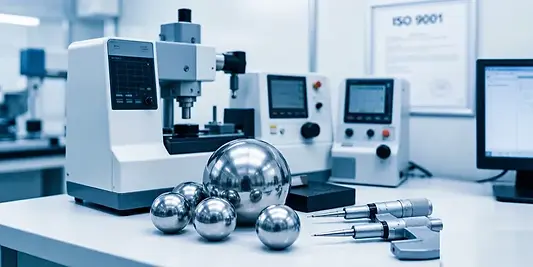
Our balls achieve sphericity within ±2 µm, surface roughness Ra 0.025 µm, and pass 100% vacuum seal testing at 85 kPa for 5–12 seconds. Seats are machined to drawing with OD Ra 1.6, end-face Ra 0.4–0.8, and sealing-line Ra 0.2.
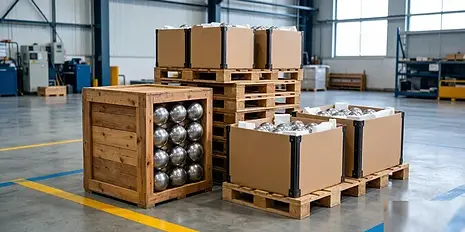
Yes. Send your part number, material, hardness, dimensional drawing, and quantity. We produce approval samples and full batches with material certificates and vacuum test records.
For general service, 9Cr18Mo at HRC 55–60 is standard. For sandy or abrasive wells, choose YG8/YG13 tungsten carbide (HRA 88–92) or Stellite (HRC 40–50). For corrosive low-abrasion wells, 6Cr18Mo or non-magnetic nickel-based alloys work well. We recommend based on your well fluid analysis.
We are ISO 9001:2015 certified and manufacture to API 11AX dimensions. Each batch includes material test reports (MTR), hardness records, and vacuum seal test records. NACE MR0175 / ISO 15156 sour-service grades and third-party inspection reports are available on request.